Understanding Your Bite And Why It Matters
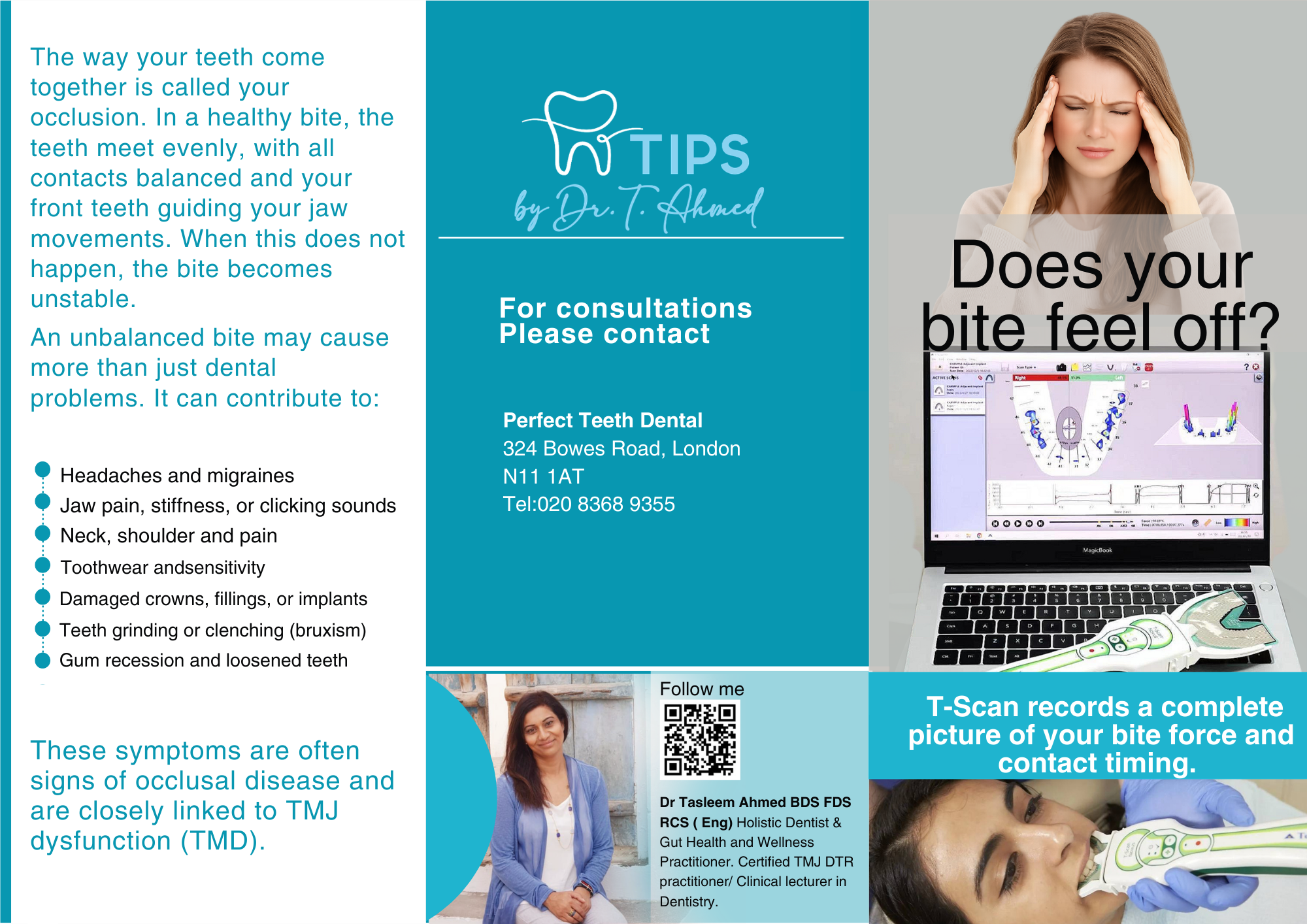
The way your teeth come together is called your occlusion. In a healthy bite, the teeth meet evenly, with all contacts balanced and your front teeth guiding your jaw movements. When this does not happen, the bite becomes unstable.
An unbalanced bite—often a sign of occlusal disease—is closely linked to TMJ dysfunction (TMD) and can cause more than just dental problems. It often contributes to:
-
Headaches and migraines
-
Jaw pain, stiffness, or clicking sounds
-
Neck and shoulder pain
-
Tooth wear and sensitivity
-
Damaged crowns, fillings, or implants
-
Teeth grinding or clenching (bruxism)
-
Gum recession and loosened teeth
What Is Disclusion Time And Why Is It Important?
When you move your jaw side-to-side or forward, your back teeth should separate within 0.5 seconds. This is called Disclusion Time.
If disclusion takes longer, your jaw muscles and TMJ are forced to absorb unnecessary stress. Over time, this can lead to muscle pain, inflammation, and significant wear on your teeth and dental work.
What Happens During A DTR Session?
A typical session is comfortable, usually requires no injections or anesthetic, and takes about 30 to 90 minutes:
-
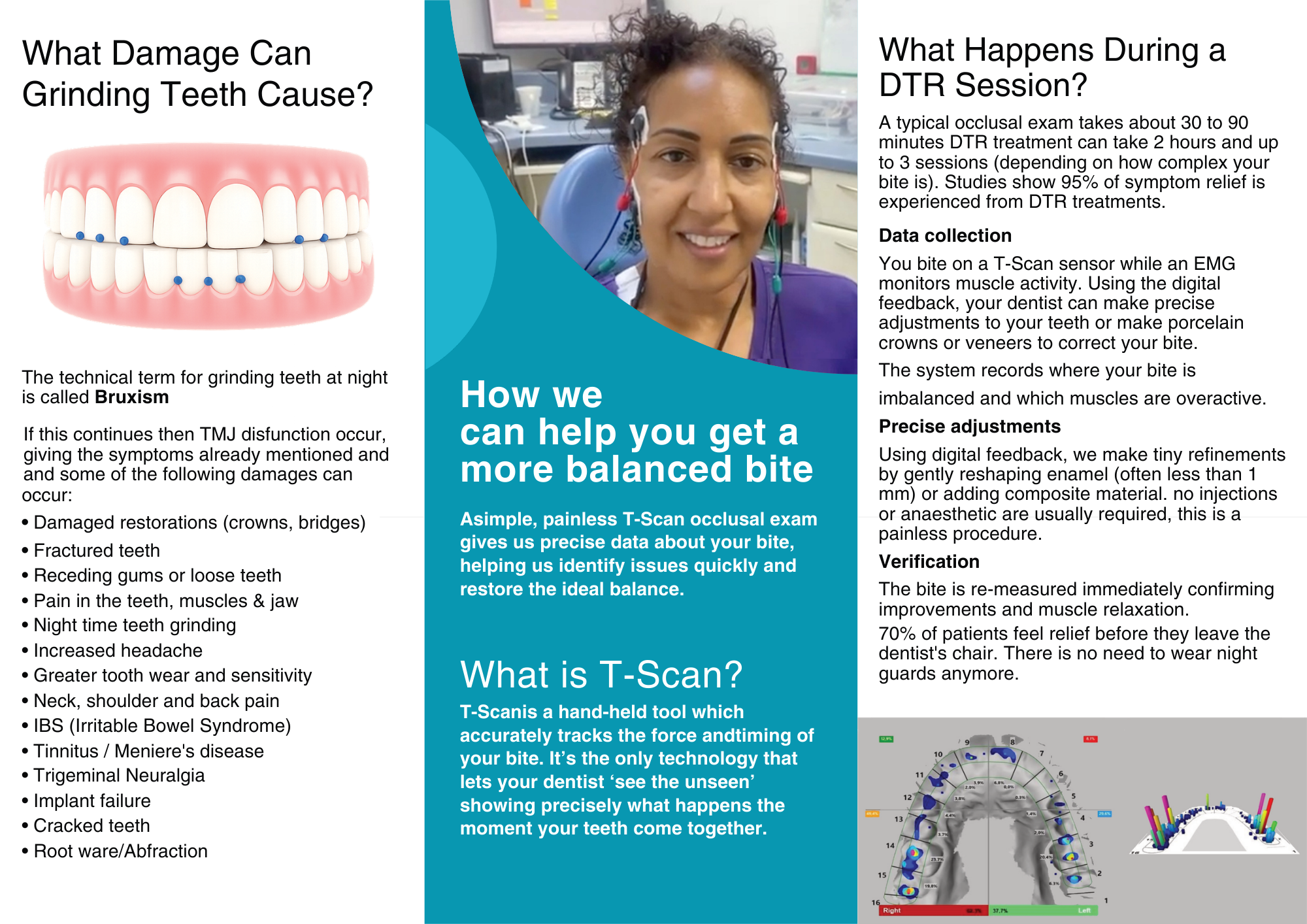
Data Collection: You bite on a T-Scan sensor while EMG monitors measure muscle activity. This system records exactly where your bite is imbalanced and which muscles are overactive.
-
Precise Adjustments: Using digital feedback, Dr. Ahmed makes tiny refinements by gently reshaping enamel (often less than 1mm) or adding composite material to correct the contacts.
-
Verification: The bite is re-measured immediately to confirm improvements. Most patients feel relief before they leave the chair.
Benefits Of DTR Therapy
DTR offers patients an advanced, conservative solution for TMJ pain and bite problems:
-
Immediate relief: Many patients notice reduced muscle pain and tension straight away.
-
Objective precision: Treatment is guided by real-time T-Scan and EMG data, not guesswork.
-
Protects dental work: Reduces excessive forces that can damage crowns, bridges, or implants.
-
Long-lasting: Reduces reliance on painkillers, splints, or nightguards.
The Bigger Picture: Occlusion, Inflammation & Systemic Health
Integrating the connections between your bite and whole-body wellness.
Research shows that an unbalanced bite contributes not only to TMJ pain but also to chronic inflammation throughout the body. As a dentist with a focus on TMJ and occlusal therapy, Dr. Ahmed addresses how correcting the bite improves systemic wellbeing.
1. Chronic Periodontal Microtrauma & Bacterial Spread Excessive occlusal forces (bruxism, premature contacts) cause microtrauma to the periodontium. This can lead to disruption of the epithelial barrier, allowing bacteria (such as P. gingivalis and F. nucleatum) to enter the bloodstream. This triggers the release of inflammatory cytokines (IL-6, TNF-α, CRP), which can worsen systemic conditions like cardiovascular disease, diabetes, and autoimmune disorders.
2. TMJ Dysfunction (TMD) & Neurogenic Inflammation Poor occlusion stresses the TMJ and trigeminal nerve, leading to chronic low-grade neurogenic inflammation. This is often linked to elevated cortisol levels, worsening headaches, fibromyalgia, and chronic pain syndromes.
3. Airway Dysfunction & Hypoxia-Induced Inflammation Malocclusion (especially deep bites and narrow arches) can compromise airway space, leading to sleep-disordered breathing or mild OSA. This causes intermittent hypoxia, triggering systemic oxidative stress and increasing the risk of metabolic syndrome.
4. Bite Force Imbalance & Systemic Muscle Hyperactivity Hyperactive masticatory muscles can trigger widespread myofascial inflammation and central sensitization. DTR therapy helps balance these bite forces, reducing EMG activity and lowering the body’s overall inflammatory load.
In Summary
Your bite affects much more than your teeth. By measuring and correcting disclusion time with advanced tools like T-Scan, DTR Therapy offers an accurate, non-invasive way to relieve TMJ pain, protect your oral health, and improve your overall wellbeing.